
Earlier, the RBI had imposed similar restrictions on commercial banks and NBFCs.

'EPFO's investments this financial year should be Rs 1 lakh crore'

In 2013-14, the funds witnessed outflow of Rs 2,293 crore

Bajaj Finance led the Sensex gainers' chart, spurting up to 2.38 per cent, followed by Bajaj Finserve rising 2.11 per cent and IndusInd Bank closing 1.66 per cent higher. Bharti Airtel, SBI and L&T increased by 1.60 per cent, 1.28 per cent and 0.92 per cent, respectively.


The EPFO had decided that 8.15 per cent interest from its debt income would be credited immediately and the remaining 0.35 per cent capital gains from the equity sale would be given later, subject to its redemption.

Hong Kong has regained its spot as the world's fourth-largest market following a broad market rout in Indian equities. Currently, the Chinese territory's market capitalisation stands at $4.9 trillion versus India's $4.75 trillion, according to data compiled by Bloomberg. In January, the domestic equity markets' market capitalisation had surpassed that of Hong Kong following a spectacular rally in the small- and midcap stocks.

In last few years, a number of global players have exited the Indian mutual fund business.

Sebi on Thursday sent a notice to fugitive businessman Mehul Choksi asking him to pay Rs 5.35 crore in a case pertaining to fraudulent trading in the shares of Gitanjali Gems Ltd and warned of arrest and attachment of assets as well as bank accounts if he fails to make the payment within 15 days. The demand notice came after Choksi failed to pay a fine imposed on him by the Securities and Exchange Board of India (Sebi). Choksi, who was the chairman and managing director as well as part of promoter group of Gitanjali Gems, is the maternal uncle of Nirav Modi.

Brokers also want tax rebates, removal of additional tax on dividends, streamlining of GST...

Equity mutual funds witnessed an outflow of Rs 9,253 crore in January, making it the seventh consecutive monthly withdrawal, primarily due to profit booking and portfolio rebalancing amid markets touching new highs. The pace of outflows from equities has however slowed for the third month and Gautam Kalia, head - Investment Solutions, Sharekhan by BNP Paribas said that it will likely turn positive soon as investors get used to the new normal. In addition, investors pulled out Rs 33,409 crore from debt mutual funds last month after investing Rs 13,863 crore in December, data from the Association of Mutual Funds in India showed on Tuesday.
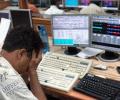
Bajaj Finserv was the biggest loser among the Sensex constituents, sliding 3.81 per cent, followed by Bajaj Finance, Tata Steel, Reliance Industries, HCL Tech, SBI, Larsen & Toubro and Mahindra & Mahindra, Axis Bank and Titan. On the other hand, Kotak Mahindra Bank, Infosys, Tech Mahindra, Power Grid, Asian Paints and Wipro were the gainers.

The NSE and BSE made Rs 965.5 crore (Rs 9.65 billion) and Rs 135.2 crore (Rs 1.35 billion), respectively, in profits for FY14.
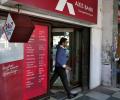
Last week, govt sold shares worth Rs 220 crore in the open market without making a formal announcement. The deal came to light only this week.

The fate of the $10 billion merger between Zee Entertainment Enterprises and Culver Max Entertainment, formerly Sony Pictures Networks India, is hanging by a thread, with the two parties unable to finalise an agreement as the end of the one-month grace period looms. The two parties are yet to come to an agreement over Zee Entertainment Enterprises Ltd (ZEEL) MD and CEO Punit Goenka leading the merged entity after Sony expressed concerns after market regulator Sebi barred him from holding managerial posts in Zee and any of the entities in a fund-diversion case.
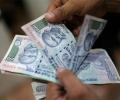
Strength in dollar against some other currencies overseas weighed on the rupee

ICICI Bank was the top loser along with index heavyweights RIL, ITC and HDFC.

The local currency had gained 17 paise to close at three-month high of 66.37 in Wednesday's trade.

In the face of tax blow, brokerages remain sanguine about the prospects of asset management companies (AMCs). A sharp correction in the shares of AMCs over the past three months factors in most of the negatives and turned valuations attractive, observe analysts. In its latest report, Kotak Institutional Equities (KIE) has upgraded HDFC AMC to 'add' (from 'reduce') and reprised 'add' and 'buy' ratings on the rest of the listed AMCs - Nippon, UTI, and Aditya Birla Sun Life.

Market regulator is trying to build a large team of software experts for efficient monitoring and surveillance

Domestic mutual funds (MFs) have underpinned demand for most public floats this year, dominated by small- and mid-sized initial public offerings (IPOs). Of the 24 IPOs that have hit the market so far this financial year (2023-24, or FY24), MFs have played the role of 'anchor investors' in 20. They have subscribed to over 40 per cent, or Rs 2,850 crore, worth of shares of the Rs 6,900 crore on offer in the anchor category, according to data provided by PRIME Database, a firm that tracks primary market data.

Gearing up to ensure greater compliance by companies to listing agreement, NSE is planning to increase its headcount to bring in more efficacy in its oversight role as a front-line regulator of the securities market.

The froth in the small and midcap (SMID) space is limited to a few pockets, but regulatory scrutiny could lead to sustained volatility, observe India's top-drawer wealth managers. They add that they have been advising clients to reduce their exposure to smallcaps. Anand Rathi Wealth, which manages investor wealth through mutual funds (MFs), reports that its exposure to smallcap stocks, both through MFs and directly, has decreased by nearly 7 percentage points in the past few months, now standing at 23 per cent.

Wipro was the biggest loser among Sensex firms, sliding 2.32 per cent, followed by HDFC Bank, Power Grid, UltraTech Cement, ITC, ICICI Bank and Tata Motors. IndusInd Bank, Maruti, State Bank of India, Mahindra & Mahindra, Asian Paints and Bajaj Finserv were among the gainers.
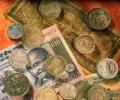
Citibank's Securities and Fund Services said on Monday it will offer securities lending services to its clients in India.

The 8.1 per cent interest rate was recommended by the Central Board of Trustees after its meeting in Guwahati under the chairmanship of Union Labour and Employment Minister Bhupendra Yadav, a labour ministry press statement said.

Friday will be a landmark day for domestic markets, with all the listed stocks entering the professed T+1 (trading plus one day) settlement cycle. About 200 stocks, which account for more than 80 per cent of India's market capitalisation, will be settled on a next-day basis, with effect from January 27. This will evidently complete the transition to the T+1 cycle that started in February 2022 with the bottom 500 stocks in terms of market value.
The remaining 0.35 per cent will be credited in December this year, if the EPFO is able to redeem its equity investments.

One category which stands out is fixed maturity plans due to its tax benefits, notes Prateek Mehta, CEO and company-co-founder, Upwardly.in.

From the Sensex pack, HDFC, HDFC Bank, Mahindra & Mahindra, UltraTech Cement, Tata Steel, Bajaj Finance, State Bank of India, Reliance Industries, Bajaj Finserv and ICICI Bank were the major gainers. Power Grid, Maruti, Tech Mahindra, IndusInd Bank, HCL Technologies and Axis Bank were among the laggards.

Damage from new shenanigans can be contained if regulators move quickly when something does not smell right, counsels Debashis Basu.

When Biocon chairperson Kiran Majumdar-Shaw - well known for raising issues ranging from lack of civic services in Bengaluru to climate change - decided to take on the Indian stock market regulator, the Securities and Exchange Board of India (Sebi), she forced the Indian corporate world and legal community to take notice. In an interview to Business Standard, Majumdar-Shaw called a Sebi order to impose a fine on insider trading charges against a Biocon employee and an external consultant an "Agatha Christie" fiction, which destroyed the reputation of "innocent people". "The order is pure harassment and has caused huge reputational damage to us and goes against the principles of good governance promised by this government," Mazumdar-Shaw said. "We will certainly appeal this," she added.

One risk of investing in a very low-cost ETF is if a fund house runs it at below cost, it could close it if it fails to attract institutional money

The government should partner with commodity exchanges such as MCX.
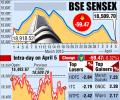
BSE-FMCG, consumer durables, pharmaceuticals led declines.

The 30-share BSE index reclaimed the 30,000-mark to trade at a new record high of 30,071.61 by surging 128.37 points, or 0.42 per cent. This surpassed the previous record high of 30,024.74 (intra-day) that the Sensex touched on March 4, 2015.
Currently, trades on the Indian stock exchanges are settled within two days, just like most major markets such as Singapore, Hong Kong, Australia, Japan, and South Korea. Indian exchanges, however, will be moving to T+1 settlement from February 25 in a phased manner.

Are you debating between buying physical gold and investing in paper gold schemes or ETFs? Anil Rego has the answer

The collapse of Silvergate Bank, Silicon Valley Bank (SVB) and Signature Bank in the US might create temporary liquidity issues but will not have any significant impact on the Indian crypto market in the long run, officials from several exchanges told Business Standard. All three banks are considered crypto-friendly. SVB offered services such as cryptocurrency custody and lending.

The rupee gained 11 paise to 82.68 against the US dollar in early trade on Tuesday as the American currency retreated from its elevated levels. Forex traders said sustained foreign fund outflows weighed on the local unit and restricted the appreciation bias. At the interbank foreign exchange, the domestic unit opened at 82.69 against the dollar and marginally rose to 82.68, registering a rise of 11 paise over its previous close amid a positive trend in domestic equities.
